Tile Roof Flashing and Valley Problems Explained
Why tile roof flashing and valley problems leak, what they cost to fix in Laguna Niguel, and how to tell a valley leak from a broken tile.
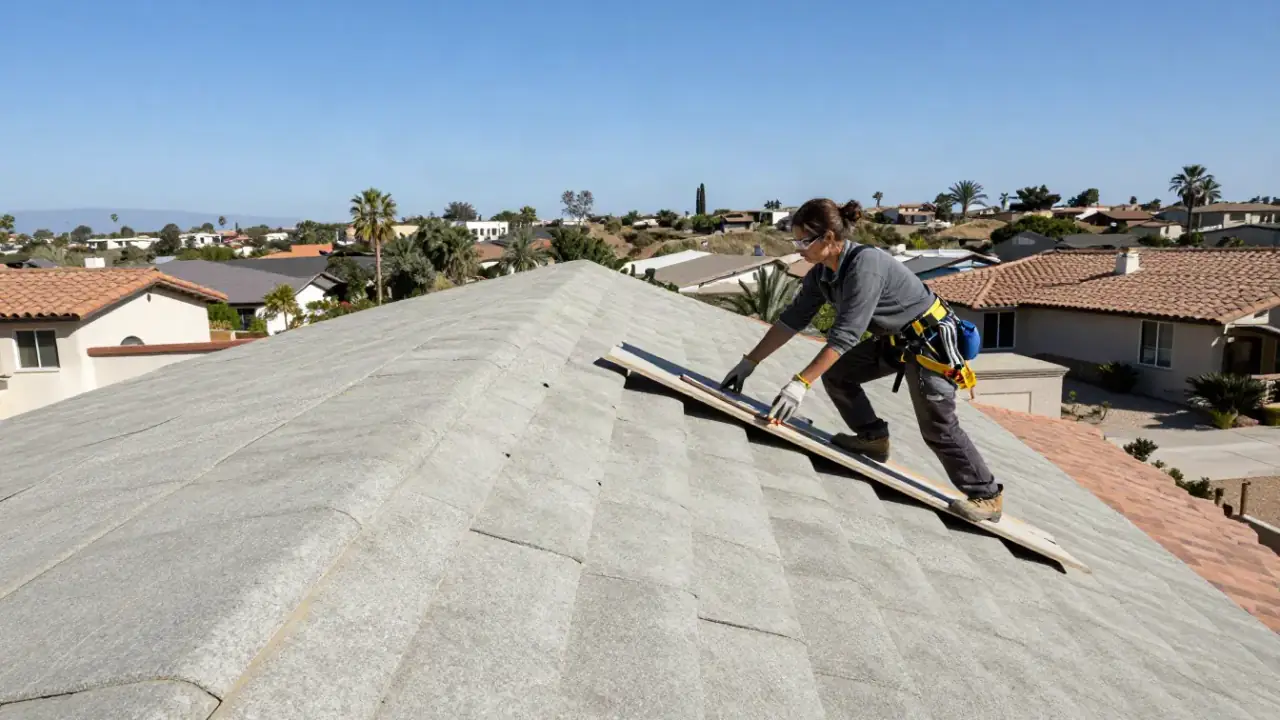
Tile roof flashing and valley problems are the two most common sources of leaks on tile roofs in Laguna Niguel, and they almost never start with the tile itself. Flashing is the metal that seals every roof-to-roof and roof-to-wall joint; the valley is the channel where two roof planes meet and dump water. When either one fails, water runs sideways under the tile and shows up on your ceiling far from the actual break.
This post walks through why these two areas fail first, how to tell a valley leak from a broken tile, what repairs cost in 2026, and when it is worth calling us instead of climbing up yourself.
Why Flashing and Valleys Fail First on a Tile Roof
Flashing and valleys fail first because they are the only places on a tile roof where water is deliberately concentrated and redirected. A field of flat or barrel tile sheds water by gravity; a valley has to handle the runoff from two full slopes at once, and flashing has to bridge materials that expand and contract at different rates.
Tile roof flashing and valley problems is the category of roof damage that involves the metal and membrane components at roof intersections, penetrations, and drainage channels - not the tile surface itself. That distinction matters, because replacing cracked tiles will not stop a leak that is coming from the metal underneath.
Three things drive the failure here in south Orange County:
- Thermal cycling. Laguna Niguel swings from cool marine mornings in the 50s to afternoon sun that pushes tile surfaces past 140°F. Metal flashing moves with every one of those swings. Sealant does not.
- UV and salt air. We are 2 to 5 miles from the coast. That is close enough for salt-laden air to attack fasteners and for UV to bake out the mastic around every penetration.
- Age. Most of the tile roofs in Laguna Niguel were installed between the late 1970s and the mid-1990s. The tile is often still fine. The underlayment and flashing from that era are not.
If you are chasing a leak and not sure where it starts, a Roof Inspection Laguna Niguel CA will map the whole roof and tell you whether the problem is flashing, valley, underlayment, or a combination.
What Causes Flashing Leaks on Tile Roofs in Laguna Niguel?
Flashing leaks on tile roofs in Laguna Niguel come from four specific failure points: failed sealant at the flashing edge, corroded or undersized metal, missing kick-out flashing at sidewalls, and fasteners that have backed out of the tile above the flashing.
Here is what each one looks like on a real roof.
Failed sealant at the flashing edge
The sealant bead along the top edge of a piece of flashing is the first thing to go. It cracks, pulls away from the tile, and leaves a 1/16-inch gap that looks harmless. During a 20-minute winter storm, that gap can pass several gallons of water into the underlayment.
Corroded or undersized metal
Original 26-gauge galvanized flashing from the 1980s is often rusted through at the bends. We also find flashing that was installed too short - less than the 4-inch minimum overlap that keeps wind-driven rain from getting behind it.
Missing kick-out flashing
Kick-out flashing is the small angled piece that throws water away from a sidewall where a lower roof meets it. When it is missing, water runs straight down the wall, behind the stucco, and into the framing. This is one of the most common hidden leaks we find in Niguel Woods Tile Roof Repair and other neighborhoods with two-story sidewalls meeting single-story roofs.
Fasteners backing out
Nails and screws that hold flashing in place work loose over 20-plus years of thermal movement. Once the flashing lifts even a quarter inch, the next rain event finds it.
If your leak is coming from a chimney rather than a wall or valley, that is a separate repair - we cover it under Chimney Flashing Repair Laguna Niguel CA.
How to Fix Roof Valley Leaks in Laguna Niguel CA
Roof valley leaks in Laguna Niguel CA are fixed by rebuilding the valley from the underlayment up: strip the tile back 3 to 4 feet on both sides, replace the valley metal or membrane, reinstall the tile, and re-flash the edges. Patching the valley from the top almost never holds.
There are three valley systems on tile roofs in this area, and the repair depends on which one you have:
- Open metal valley. The tile stops short and you see a strip of metal. Easy to inspect, easy to repair. Most common on 1980s and 1990s builds.
- Closed or California cut valley. The tile from one slope runs across the valley and the other slope is cut to it. Looks cleaner, but the cut edges are where leaks start.
- Woven valley. Tile from both slopes interlaces. Rare on tile, common on shingle, and the hardest to repair without removing tile.
The actual repair sequence we use on a valley leak:
- Remove tile 3 to 4 feet back from the valley centerline on both sides.
- Inspect the underlayment. If it is original 15-pound felt from the 1980s, it is done - replace it in the repair zone.
- Install new valley metal, minimum 26-gauge, with a 4-inch minimum lap.
- Install a self-adhered ice-and-water membrane 12 to 18 inches wide centered on the valley.
- Reinstall tile with new fasteners, cutting the valley edges clean.
- Water-test the repair before we leave.
A single valley repair usually takes 4 to 8 hours on site. If the underlayment in the repair zone is failing, we will tell you - and that is often the moment to talk about Tile Roof Underlayment Replacement Laguna Niguel CA for the whole roof instead of patching one valley at a time.
Can Flashing Problems Be Repaired Without Replacing Tiles?
Yes - in most cases we repair flashing without replacing the tile field. We lift the tile, fix the metal and underlayment underneath, and set the original tile back down. Tile is reusable; the components under it are not.
The exception is tile that breaks during removal. Clay and concrete tile from the 1980s gets brittle, and we typically break 5 to 10 percent of the tile we lift. We keep matching tile on hand for the common profiles in Laguna Niguel, and when we cannot match exactly, we pull tile from an inconspicuous area like behind a chimney and use the new tile there.
What we do not do is seal a flashing leak from the top with mastic and call it repaired. That buys you one or two rainy seasons at best. The fix has to happen at the metal.
If the tile itself is cracked or broken - which is a separate problem from flashing - that falls under Broken Tile Repair Laguna Niguel CA.
What Flashing and Valley Repair Costs in 2026
Typical 2026 pricing in Laguna Niguel for flashing and valley repair runs $450 to $1,200 for a single flashing repair and $1,100 to $2,800 for a full valley rebuild, depending on how much tile has to come up and whether the underlayment in the repair zone is reusable.
What moves the number up or down:
- Access. A two-story valley over a tile patio costs more than a single-story valley over dirt. Staging and fall protection add 1 to 3 hours.
- Tile condition. If the tile lifts clean, labor is lower. If it shatters, we are replacing tile as well as flashing.
- Underlayment scope. A flashing repair on top of sound underlayment is a half-day job. A valley rebuild that uncovers failed felt turns into a bigger repair.
- Number of penetrations. A chimney, two vent pipes, and a skylight in the same area means more flashing to rebuild.
We give you the price before we start, and it does not change unless we open up the roof and find something we could not see from the surface. If that happens, we stop and walk you through it.
Common Mistakes We See on Laguna Niguel Tile Roofs
The most expensive mistake we see is treating a valley leak as a tile problem. Homeowners replace cracked tiles, the leak continues, and by the time we get up there the underlayment and sheathing have been wet for two or three seasons.
Other repeat offenders:
- Sealing over failed flashing. Mastic and roof cement are temporary. They crack within 12 to 18 months in our UV load.
- Pressure-washing the roof. It drives water under the tile and strips the surface. If your roof is dirty, Tile Roof Cleaning Laguna Niguel CA is the right call - not a pressure washer.
- Ignoring a small ceiling stain. A dime-sized stain in October is often a 6-inch wet patch in the sheathing by February.
- Letting a handyman walk the tile. Tile cracks under foot traffic. We use foam walk pads and stay on the load-bearing lines.
- Replacing the whole roof when only the flashing failed. If the tile is sound and the underlayment is intact, a targeted repair is the right answer.
When to Call a Professional
Call us when you see any of these: a ceiling stain that grows after rain, water in the attic after a storm, tile that has shifted near a valley, or daylight visible at a flashing edge from inside the attic.
We are Laguna Niguel Tile Roof Repair, and flashing and valleys are what we do most. We find the leak, fix the metal and membrane underneath, set your tile back, and water-test before we leave. If the repair is small, we will tell you it is small.
For roofs where the flashing is sound but the tile has started to slip or the ridge line has opened up, the right service is Ridge Tile Re-Securing Laguna Niguel CA. And if the roof is past the point of repair, we handle Tile Roof Re-Roofing Laguna Niguel CA as well.
We serve the whole city, from Tile Roof Repair in Crown Valley Highlands down to the coast, and we know the roof profiles in each neighborhood.
Frequently Asked Questions
What causes flashing leaks on tile roofs in Laguna Niguel?
Failed sealant, corroded metal, missing kick-out flashing, and loose fasteners. Our UV load and coastal salt air accelerate all four. Most flashing leaks we see trace back to original 1980s or 1990s galvanized metal that has rusted through at the bends.
How do you fix a roof valley leak in Laguna Niguel CA?
Strip the tile 3 to 4 feet back on both slopes, replace the valley metal and underlayment, reinstall the tile, and water-test. A single valley rebuild takes 4 to 8 hours. Top-side patching does not hold through a rainy season.
Can flashing problems be repaired without replacing tiles?
Yes. We lift the tile, repair the metal and underlayment, and set the original tile back. Expect 5 to 10 percent breakage on older clay and concrete tile; we keep matching profiles on hand for common Laguna Niguel roofs.
Who repairs tile roof flashing near me in Laguna Niguel?
We do. Laguna Niguel Tile Roof Repair handles flashing, valley, chimney, and skylight leaks across the city. Call us and we will get eyes on the roof, tell you what failed, and give you a price before we start.
How much does tile roof flashing repair cost in Laguna Niguel?
In 2026, a single flashing repair runs $450 to $1,200. A full valley rebuild runs $1,100 to $2,800. Access, tile condition, and whether the underlayment in the repair zone is reusable are the three biggest cost drivers.
Get Help with Tile Roof Repair in Laguna Niguel
If you have a leak you cannot pin down, or you know it is coming from a valley or flashing and want it fixed right, call us. We will find it, fix it, and show you what we did.
Call Laguna Niguel Tile Roof Repair at (949) 670-0283 to schedule a flashing and valley inspection.